
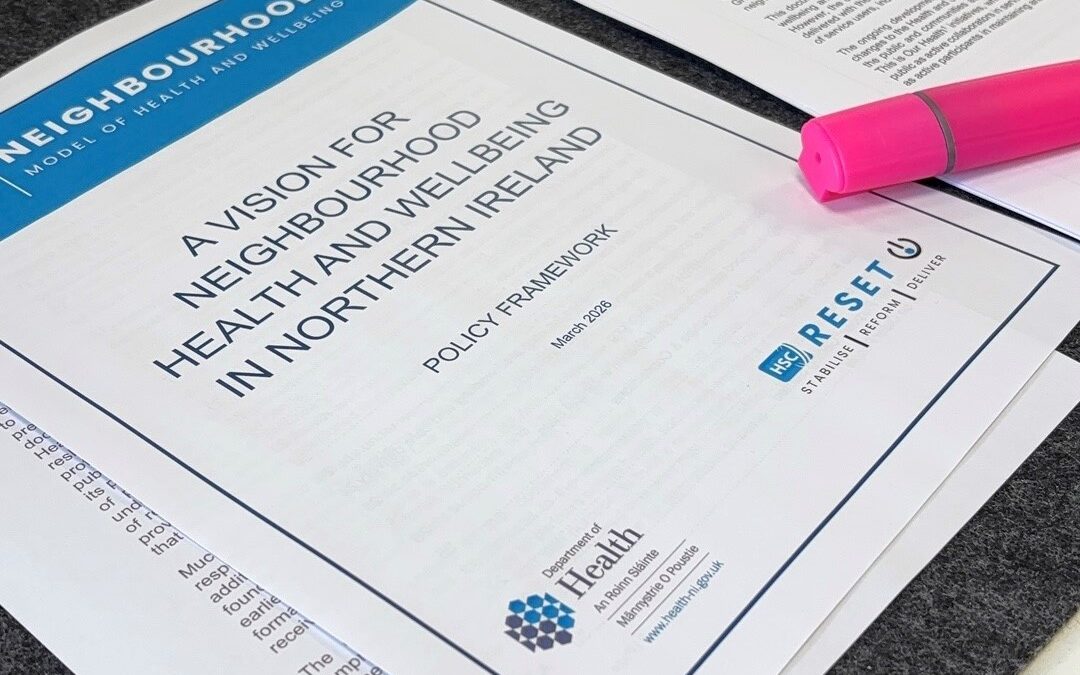
The Department of Health’s new neighbourhood model of health and wellbeing, published last week, sets out an ambitious and welcome shift towards prevention, early intervention and more integrated support.
It marks the latest step in a wider programme of reform aimed at transforming how — and where — health and social care is delivered across Northern Ireland.
At the same time, Inspire recently launched Inspire 31, a five-year strategic plan shaped by the voices of over 700 people and built around our three aims of wellbeing, ability and recovery. It acknowledges both the complexity of people’s needs and the significant pressures facing health systems across the island of Ireland. Our strategy also prioritises early intervention, along with community connection and personalised support. Notably, these priorities closely follow the direction of travel set out in the Department’s model.
We welcome the Northern Ireland Executive’s focus on person-centred, community-based services that are accessible, inclusive and responsive to the realities of local need. Its commitment to addressing the drivers of health inequalities reflects long-standing reform principles.
Partnerships as the Foundation of Local Transformation
Four key tenets will underpin the model, with the most important, arguably, being ‘Neighbourhood Relationships & Connections’. Effective cooperation between statutory partners and, critically, the VCSE sector will be essential if prevention, early intervention and community-led approaches are to succeed.
In 2025, the Executive and the voluntary and community sector published a new Partnership Agreement. This accord provides an important test of the government’s pledge to collaborate on fundamental decisions.
Inspire’s €7.7m PEACEPLUS project, Right Support Right Time, delivered alongside six other leading charities across Northern Ireland and Ireland, highlights the impact that strong alliances can have in effecting meaningful change.
Clarity Is Essential to Implementation
Whilst the Department’s latest framework sets out a clear vision and strong principles for neighbourhood working, it offers limited detail on the steps required to achieve meaningful results. There is a real risk that, without defined guarantees, progress may occur at different speeds and in inconsistent ways, undermining the model’s core purpose.
With its focus on person-centred care, prevention and early intervention, and VCSE partnerships, the neighbourhood model reflects many of the core principles of the Bamford review. In several respects, it can be seen as a contemporary expression of Bamford’s critique of institutional, crisis-driven systems. The emphasis on strengthening community-based support and enabling people to play a more active role in shaping their own care similarly mirrors the review’s recommendations.
However, Bamford was clear that successful reform depends not only on vision, but on robust application. That review concentrated on regional equity, clinical clarity, protected priority for mental health, workforce expertise and meaningful accountability. As its roll-out continues, how the model addresses each of these requires further clarification.
Although the proposals set out a helpful long-term ambition around structures, relationships and joint working, they do not yet provide the operational steps, measurable indicators or implementation milestones that Integrated Neighbourhood Teams (INTs) will be expected to deliver. In their absence, the possibility of further fragmentation becomes very real, potentially creating variability across health and social care trusts and adversely affecting the very people that the model has been created to help.
The early stages are framed primarily around relationship building and development activity, rather than clear, outcome-aligned actions. The divergence of policy intent and real-world delivery is an all-too-familiar occurrence. Without operational insights, strategic ambition could outpace practical implementation.
A further consideration is workforce readiness. The model points towards more preventative, relational and community-centric ways of working. Ensuring and sustaining the requisite skills and capacity, along with finally addressing issues relating to pay equity for social care staff, will prove important if the Department’s objectives are to be met.
Structural Complexity and Regional Consistency
The proposed structure — one regional collaborative board, five local collaborative boards and 17 individual neighbourhood partnerships — is complex and adds up to 23 separate engagement points for region-wide organisations like Inspire.
Such fragmentation may well place additional operational pressures on providers and give rise to inconsistent commissioning across Northern Ireland. The plan for multiple localised decision-making forums could see the emergence of conflicting priorities, a situation likely to limit the ability of regional organisations to deliver unified services.
The geographical spread of INTs may also prove challenging. In some trust areas, including Belfast, multiple teams will operate simultaneously. While flexibility is important, robust regional coordination and shared standards are equally essential. Without these, geography and local configuration, instead of assessed need, could begin to shape access to services, running counter to the Minister of Health’s stated ambition to move away from postcode lotteries in health and social care.
The Mental Health Strategy 2021-2031 advocated for a single, coherent regional system. Unless carefully designed, the proposed neighbourhood arrangements might end up recreating the very variability that transformation efforts have long sought to counter.
We are concerned, too, that desired mental health outcomes are in danger of becoming overshadowed by the broader neighbourhood agenda. Given the existing and well-documented strains on the NHS as a whole, the prospect of an already under-resourced mental health system being deprioritised is extremely concerning.
In spite of these challenges, Inspire remains optimistic about the neighbourhood model and awaits the publication of the governance framework by the Strategic Planning and Performance Group. Precise guidance on monitoring, measurement and accountability constitutes a vital component of consistent progress.
Resourcing the Model for Success
The introduction of a significant reform during a challenging financial period, with only ‘limited additional resources’ earmarked for its delivery, undermines confidence in the model’s deliverability.
Neighbourhoods across Northern Ireland vary greatly in terms of infrastructure, workforce capacity and community assets. Without a structured approach to levelling up, areas with fewer resources may struggle to operate at the same level as less-deprived localities. In an era of ongoing in-year overspends and emerging financial pressures, clear advice on investment priorities is particularly important.
The recent removal of Action 17 from the Mental Health Strategy Deliverability Review is a reminder that, when budgets tighten, collaboration and integration can become vulnerable. That experience informs our cautious stance. The neighbourhood model needs safeguards and dedicated resourcing for mental health.
An Invested Stakeholder
As the new model begins to take shape, Inspire will remain an invested stakeholder. We look forward to embedding wellbeing for all in every community and we remain committed to ensuring that the insights, expertise and experiences of our service users guide programmes of reform.

Kyle Duncan
Engagement and Public Affairs Manager

Matthew Coyle
Policy and Campaigns Officer