
Over the course of the past few months, Inspire has been speaking — and listening — to individuals with lived experience of supported housing, as well as frontline staff, sectoral partners, policymakers and elected representatives.
Our aim has been to understand what supported housing means in people’s lives and the challenges that must be addressed in the years ahead.
Throughout those conversations, one question kept resurfacing:
Is our supported housing system evolving at the same pace as the needs of the people who depend upon it?
—————————
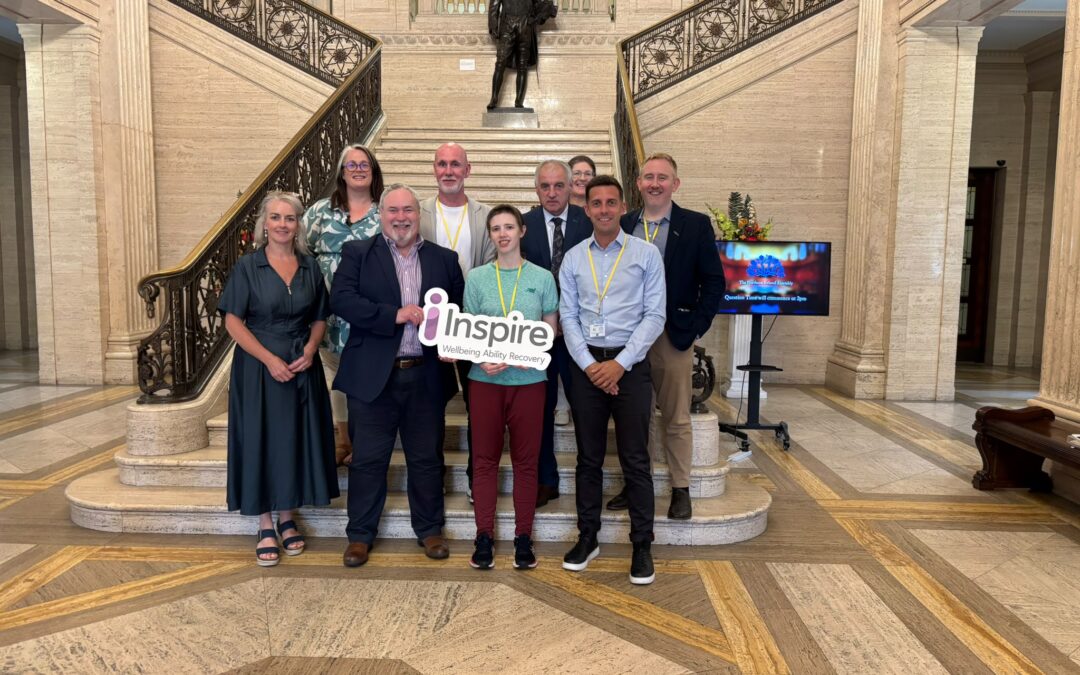
Last week, we had the opportunity to share this learning with the Northern Ireland Assembly’s Committee for Communities. That discussion presented the learning generated by our many meetings and engagement workshops. It painted a clear picture of the value of supported housing and the pressing challenges that we must tackle moving forward.
We left the Committee with one clear message: supported housing works.
People who access our services have spoken to us about safety, stability, community and recovery. They have described the positive difference that the right combination of housing and support makes in their lives.
One of those stories was shared with the Committee by Katy McQuillan, a member of Inspire’s Service User Reference Forum.
Reflecting on her own journey, Katy said:
“Supported living gives people the opportunity to be independent while also being part of a supportive community. It helps people live well, build confidence and feel connected to one another and to society.“
Katy’s testimony underlines the importance of accommodation that reflects a diversity of circumstances and aspirations. For some, shared living arrangements build connection and community. For others, more independence provides the right foundation for recovery and wellbeing.
The principle is clear. People must have access to the right home, alongside the right support, when they need it.
Supported housing is, after all, about much more than a roof over one’s head. It is about creating the conditions that allow people to live well.
As our engagement process progressed, another fundamental issue emerged. Northern Ireland requires more supported housing, of course, but it should also be the right kind of supported housing.
—————————
Needs are becoming increasingly complex. As they evolve, we must be clear about whether the accommodation and service models we rely on today will suit us tomorrow. Government should have a stronger grasp of the condition and suitability of the extant supported housing stock, whether it meets current and future need, and what level of investment is sufficient to move from a course defined by reactive provision to one of proactive planning.
This matters because housing and health are, after all, deeply connected. The right home can promote recovery, reduce isolation and prevent more intensive interventions.
—————————
Unfortunately, in Northern Ireland at least, relevant policies are still too often produced in silos.
Other jurisdictions have begun to take a more strategic approach. The Supported Housing (Regulatory Oversight) Act 2023 places new duties on local authorities in England to develop supported housing strategies, assess current provision, understand future need and operate accordingly. It introduced national standards, alongside a stronger framework for oversight and improvement.
In addition to these reforms, research commissioned by the National Housing Federation estimates that England will require at least 167,000 additional supported homes by 2040, arguing for better alignment between housing, health and care planning.
Whether those numbers could be replicated locally is not the point. The point is that Northern Ireland must be able to produce its own clear forecast of future supported housing demand.
Can we conceive of the future housing landscape? Are we able to identify the types of accommodation and support that will best serve our communities over the coming decades? And are we planning now to meet that demand?
—————————
At Inspire, we believe there exists a clear opportunity to strengthen how supported housing is understood, planned and resourced.
That necessitates a clearer comprehension of future need, along with a stronger alignment between housing, health and social care.
Most importantly, supported housing is nothing less that critical infrastructure, underpinning wider ambitions for improved social outcomes and reduced health inequalities.
Inspire supports the growing emphasis on prevention, early intervention, community-based care and independent living, as typified by the Department of Health’s recently established neighbourhood model. These principles closely align with our own and increasingly shape discussions around the future of health and social care.
These ambitions are not abstract. The right home supports recovery and prevents crisis. In the right home, a person can live with dignity, respect and hope. The experiences of people like Katy prove this to be true.
If we are serious about creating a healthier Northern Ireland, supported housing cannot remain a peripheral consideration. It must be recognised as part of the solution.