
Water Scarcity
As we’ve seen elsewhere, water covers around 70 per cent of Earth’s surface. However, access to usable water is extremely limited, with only three per cent of this being freshwater, two-thirds of which is trapped in glaciers and snowfields, leaving only one per cent of all the Earth’s water actually available for human use.
Water can be scarce for many reasons: demand for water may be exceeding supply, water infrastructure may be inadequate, or institutions may be failing to balance everyone’s needs.
Water scarcity is an increasing problem on every continent, with poorer communities most badly affected.
Read More: Water Scarcity | UN-Water
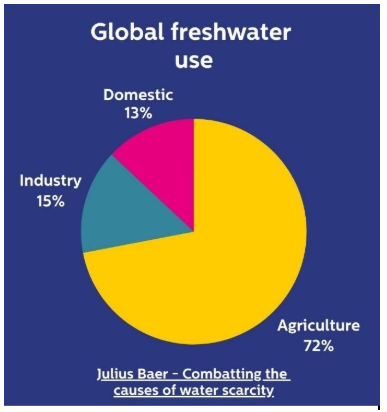
The three main drivers of water scarcity both globally and locally are agriculture, industry and domestic (municipal)
Read More: Combatting the causes of water scarcity | Julius Baer
As the global population grows, water stress and water scarcity becomes a greater risk
While Ireland and the UK remain some of the most ‘water secure’ land masses on earth, they still face the risk of water scarcity due to population growth, increasing demands on the food system, aging infrastructure, and climate-driven droughts.
Agriculture
Around 72% of all freshwater withdrawals are for agricultural reasons.
Some of the key reasons for this high level of water use are:
- Irrigation: crops require consistent water for growth. These irrigation systems are also often inefficient, which means water is often wasted through evaporation and seepage during irrigation
- Livestock feed production: a massive portion of agricultural water is used to grow feed crops (such as alfalfa, corn, and soy) for the animals that we eat
- Growing population increasing demand: As the population grows, increased demand for food – specifically water-intensive meat and dairy – increases water demand
- Climate factors: Rising temperatures and dry climates necessitate more water for irrigation to combat evaporation and sustain plant life.
- Additionally, water is used for cleaning livestock facilities, post-harvest processing, and applying pesticides and fertilizers.
You can read more here: The importance of water in agriculture
We all have to eat to survive, but the great news is that changing what’s on our plate or in our bowl can have a profound impact on our ‘water footprint’. This is because different types of foods take drastically different amounts of water to produce.
For example, meat and dairy production consumes around 41% of agricultural water despite producing only 18% of global calories.
Read more: The devastating water footprint of animal agriculture
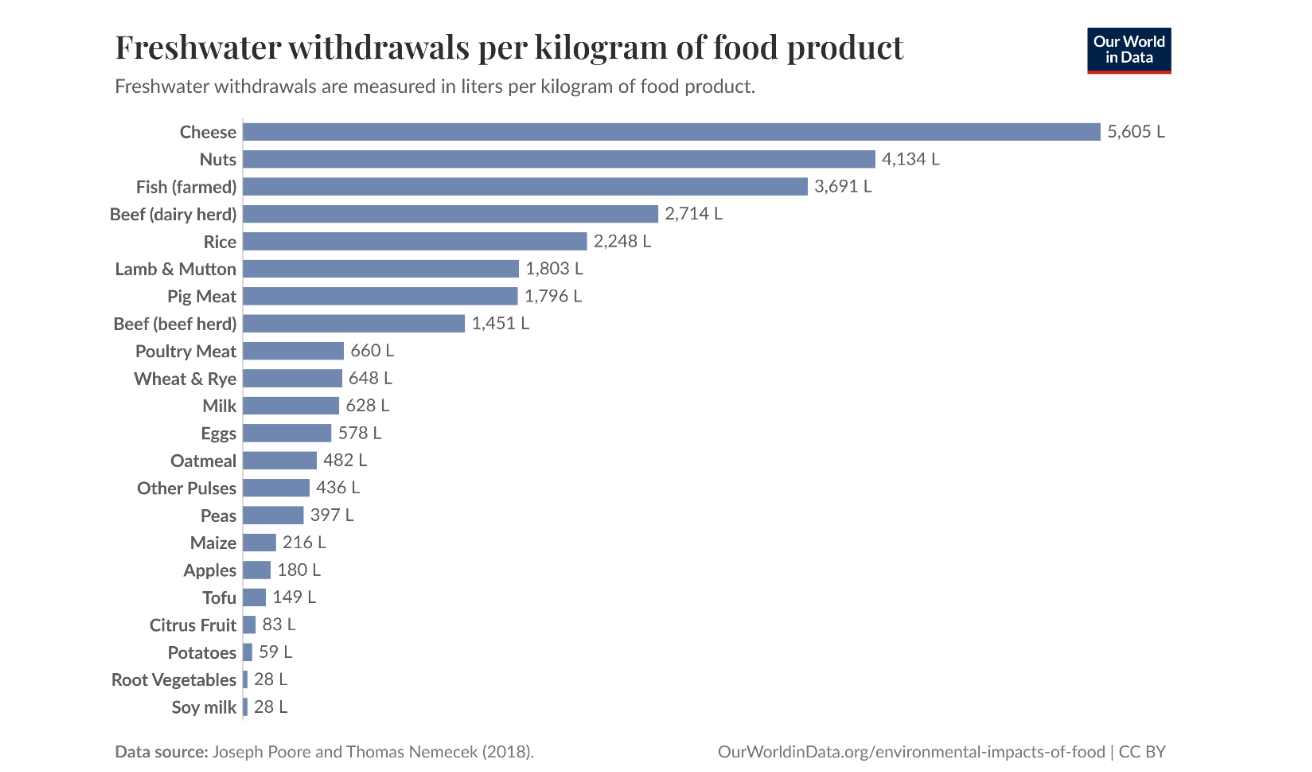
Source: Water Use and Stress – Our World in Data
Not only do different foods have different water footprints, the type of milks we choose can also make a huge difference:
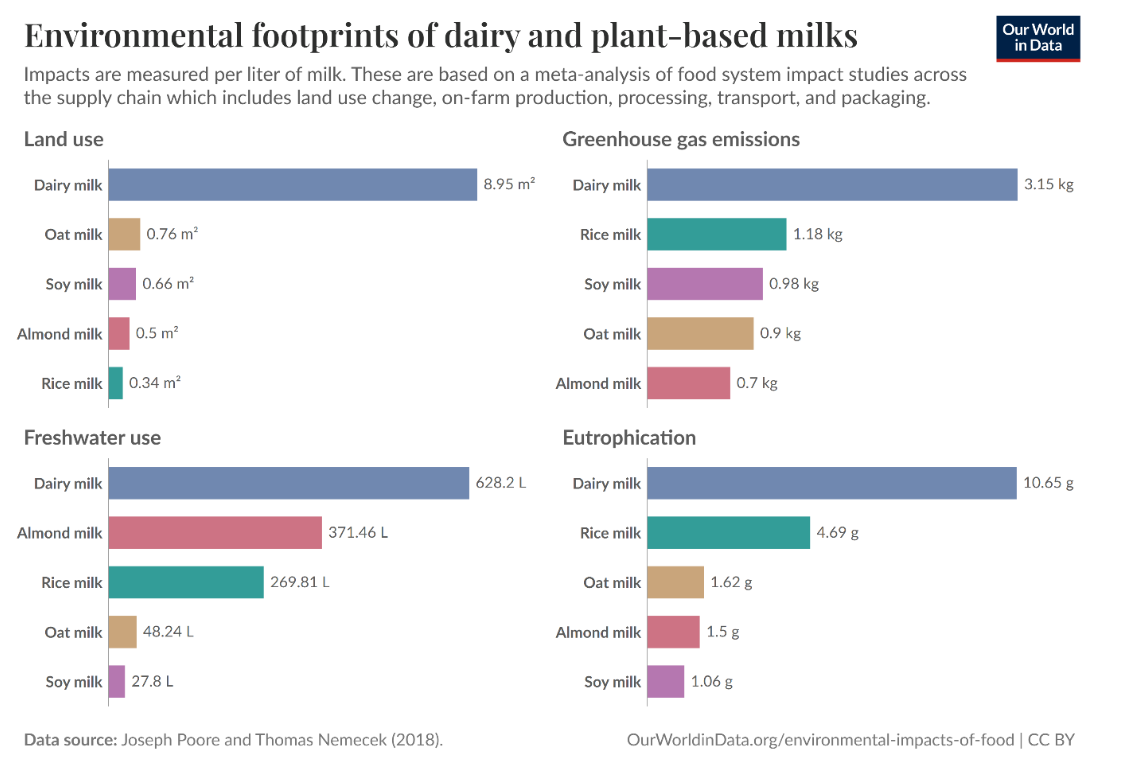
Source: Dairy vs. plant-based milk: what are the environmental impacts? – Our World in Data
The great news here is that this is something we have direct control over! We can choose what we buy, and what we consume.
Key reasons for reducing the water footprint of our food choices:
- Reduce meat and dairy consumption: it takes drastically more water to produce animal foods than it does most plant foods.
- Reduce processed food & sugar, opt for whole plant foods: Processed foods also require extensive water for sanitation, packaging, and refining, whereas whole plant foods do not. Plus, whole plant foods are healthier for our bodies too!
- Avoid Food Waste: Wasting food also wastes the water used in its production. Avoidable food waste accounts for roughly 6% of all water requirements.
Read more: The Hidden Water in Your Food: A Guide to Your Water Footprint | Food Unfolded | FoodUnfolded
Our PACT Suggestions
Meat-free one day a week!
Consider going meat-free one day a week, either individually or as a service!
Did you know, that one person eating plant-based just one day per week saves approximately 18kg of grain, up to 5000 litres of water, 30 square feet of forest, and one animal. To put that into context, 5000 litres is equivalent to almost 4 months’ worth of showers… saved in just one day, by one person.
Read more: Change the world by eating a vegan diet just one day a week – Pan Macmillan
How to do it!
1. Decide whether you want to try by yourself or as part of your service – if your service serves food, you could suggest the entire service goes meat-free one day a week!
2. Visit Meat Free Monday to learn more about the impact, to join the community, and for recipes suggestions. Of course, it doesn’t have to be Monday – any day will do.
3. Fill out your PACT sheet and keep track of your progress.
If giving up animal foods one day a week seems too challenging, you could try:
Changing milks
You could try swapping cow’s milk for oat or soy milk for a month!
One litre of cow’s milk takes around 580 litres more water to produce than one litre of oat milk. That’s around 3-4 full bathtubs of water saved per litre when you buy oat or soy milk!
Oat milk tends to cost between 20-40p more per-litre to buy, depending on where you buy it, but when we weigh up that small cost difference for such drastic water savings, it doesn’t seem like a lot – provided you can afford the difference.
If you can afford the slight cost difference:
1. Decide whether you want to try by yourself or as part of your service
2. Visit Asda, Tesco, Sainsbury’s or Lydl and buy their own-brand oat drinks: these are fortified to make them nutritionally comparable to cow’s milk, and are usually cheaper than the main brands
3. Fill out your PACT sheet and keep track of your progress.
If you swap to oat milk for one month, and you normally consumer 2 litres of cow’s milk a week, you’ll save over 4000 litres of water, in only 4 weeks!
For more information on the water footprint of different foods, check out Change Your Diet – Water Footprint Calculator.
Or, to watch a short Ted talk on the subject, check out How to eat yourself out of a water shortage | Anas Ghadouani | TEDxPerth.
Industry
Industrial withdrawals account for around 15% of all freshwater withdrawals, much of which is essential for keeping the lights on and keeping society functioning!
But much of what is produced is also driven by capitalism: that is to say, the production of non-essential products for profit-driven purposes.
And that is where we can help: by being more conscious and deliberate with how we spend our money, and adopting a more sustainable approach to energy use, we can reduce the demand for new water-intensive products, and help shape industry trends.
Read more: The Water Footprint of Industry and Manufacturing
Three industrial sectors with strong water usage
Energy sector
The energy sector requires significant amounts of water to generate power, while the water industry relies heavily on energy to power its operations. The water withdrawn for energy production is roughly ten times larger than the volume consumed.
Read more: Energy Production and the Water Footprint of Energy
Manufacturing sector
Water is essential for different industries and their operations. Water-intensive industries include chemical, pulp, paper, textile, and food and beverage. For example, producing a pair of jeans requires between three and six thousand litres of water.
Data centres
The rapid growth of artificial intelligence (AI) has increased global energy consumption and, therefore, requires substantial amounts of water each year, with an expected power demand to double between now and 2030. A considerable amount of water is used for the water-intensive cooling systems data centres need to balance their power consumption.
Read more: Combatting the causes of water scarcity
Our PACT Suggestions
Here things aren’t as straightforward as simply swapping out what’s on your plate, but we can still find suggestions against each of the sectors mentioned with approximate savings per litre.
Energy
A kWh (kilowatt-hour) is a unit of energy measuring how much electricity is used over time, equivalent to using (1 kilowatt) of power for 1 hour.
It takes a lot of ‘virtual water’ to make electricity, especially for thermoelectric power production. It also takes water to refine transportation fuels. So saving energy also save water and vice versa.
For example, a household using around 900 kWh per month can indirectly be responsible for around 12,000–36,000 litres per month of cooling water withdrawals through thermoelectric generation (based on typical estimates of 1–3 litres of water per kWh).
Reduce your household electricity consumption
Every avoided kWh saves 1–3 litres of cooling water at conventional plants.
Some general examples to visualise:
- Switching to LED lighting saves around 500 kWh per year, which is between 500–1,500 litres of water saved per year. But that doesn’t mean you should go out and replace every bulb in your house! – just wait and as your current bulbs die, replace them with LED lights over time.
- Efficient appliances can make a difference. A-rated washing machine, fridge, etc can save 300–500 kWh saved/year, which works our between 300–1,500 litres per year saved. But as above, only replace appliances once they’re broken, and you should not spend more than you can afford either.
- Smart thermostats can also save around 450 kWh saved per year, which works out around 450–1,350 litres per year.
These reductions matter because thermoelectric cooling is a major driver of water withdrawals.
For a specific PACT, we recommend:
- Making a list of all your lights / appliances that are plugged in and switched on regularly
- Setting the target of switching everything off each night before bed.
- Once you get into the habit of this, it should happen naturally!
- This could save between 130 and 400 litres of water a year – and not just water savings, it could also save up to £200 a year too in electricity bills!
Read more: Saving Energy in the Home – Stratford Climate Action
Manufacturing
Manufacturing has a massive water footprint across nearly every industrial product, from cars to paper to electronics.
There are so many different types of manufacturing that homing in on one or two aspects is difficult, but one bit of advice we often see is to buy more sustainable alternatives to common products. This is reasonable advice, but in general, almost all industrial goods have large embedded water footprints, even sustainable alternatives, and so product longevity is generally considered the single most powerful lever an individual can control.
What that means is that using what you have, for as long as you have it, and not replacing things that aren’t broken, is likely the best way to reduce your water footprint in relation to manufacturing. Second to that, buying second hand, from thrift-stores or charity shops, can also help reduce the need for new products to be developed.
Nevertheless, some general, measurable examples include:
- Delay purchasing a new smartphone unless you need it. It is common for people to upgrade their phones the moment the next upgrade comes out or when their contract ends on their current deal, but if your phone works, consider keeping it.
- Manufacturing a smartphone consumes an estimated 12,000–16,000 litres of water. Read more here: World Water Week: How Much Water Does Your Smartphone Use?
- Reduce clothing purchases (buy 5 fewer items per year). And consider buying second hand if you can find what you need.
- A typical cotton T shirt’s water footprint is around 2,500 litres.
- Saving 5 items per year would equate to around 12,500 litres saved.
- Print less! – it may not be an individual challenge but could become a service challenge.
- It takes around 5 litres of water to make one single piece of A4 paper.
For a specific PACT, we recommend:
Print less! Either as an individual or a service.
- First, calculate how much paper you or your service normally use in a month
- Aim to reduce that number by 10-20%
- If you normally print around 30 pieces of paper a month, you could save 30 litres of water a month by reducing that amount by 20%!
Data centres
Data centres are extremely waterintensive due to cooling needs. For example, a single 15-megawatt facility may use more than 1.3 million litres of water a day. However, the hope is that data centres will shift to less water intensive cooling methods in the future, for example air-cooling, which can reduce direct water-use by 95%.
Read more: Addressing the hidden water footprint of data | ViewPoint
We can’t control a great deal here, and the numbers are different based on where and how data is stored, but we can still have a small impact:
- Reduce unnecessary cloud storage and data transfer. Outbound data traffic has a water footprint of 1–205 litres per GB. [mdpi.com]. For example:
- Deleting 5 GB of unused cloud files saves between 5–1,025 litres of water.
- Turning off automatic HD backups on phones, saving around 2 GB a month of storage would equal between 24 and 4,920 litres a year.
- Limit unnecessary AI queries and streaming quality
- Reducing 10 unnecessary AI prompts a day could save 5 litres a day or 1,825 litres a year, based on 500 ml per prompt [eesi.org]
- Video streaming in SD instead of HD saves data. If HD streaming takes around 3 GB per hour of data and SD equals around 1 GB per hour, we save between 2 and 410 litres of water an hour with SD streaming. Over 5 hours a week would equal between 520 and 10,660 litres of water a year.
- Enable powersaving settings on devices. Reducing your device electricity use reduces the cooling water demand via power generation, plus it reduces heat produced in data centres, which lowers cooling requirements in data centres.
- Small changes (lower brightness, energysaving mode) can reduce device power use by 10–20%, translating into an estimated 50 to 200 litres a year saved, depending on usage.
For a specific PACT, we recommend:
Go screen-free for one day a week for a month!
Consider how much electricity your TV and other devices use, and how much water data streaming uses. Now add to that the mental health benefits associated with less screen time and more time outdoors! This is a difficult challenge, so consider whether it’s right for you.
Read more: How can you reduce the environmental impact of your next virtual meeting? | MIT Energy Initiative
- Consider whether this is something you can do, and pick the most likely day that works
- Plan for how you will spend this day: for example, spending time in blue spaces, outdoors, or visiting museums or galleries, or spending time with loved ones
- Allow yourself 10-15 minutes of phone time within this day to allow for emergencies
- Commit the plan to the PACT tracker and keep track!
Between screens and electricity usage, you could save between 10 and 2000 litres of water a day by going screen free! (This is a wide range because water intensity varies greatly by local climate (affecting cooling needs), type of data centre cooling, electricity source (renewables vs thermoelectric cooling) and streaming resolution and device type).
Domestic
What we can do at home can make a big difference too, and there are so many suggestions it can be difficult to know where to start!
For instance, check out 100+ Ways to Conserve Water to see a comprehensive list!
But we can point to a few obvious ‘easy wins’:
- Shorten showers. Standard showerheads use around 9.5 litres a minute
- Reducing your shower time by 3 minutes saves around 28 litres per shower.
- Over 30 days of daily showers this saves around 855 litres saved per month.
- Turn off tap while brushing teeth/shaving. Standard faucets use around 8 litres a minute.
- If you normally let the tap run for 2 minutes, twice a day daily, you will save up to 33 litres a day, or up to 1000 litres a month!
- Re-wear clothes that aren’t dirty. Obviously personal hygiene is important and so changing underwear and socks daily is recommended, but consider when you may be changing clothes that aren’t dirty unnecessarily.
- If you wash normally wash 4 loads a week, this equates in a normal machine to around 568 litres of water
- Reducing your washing by one load a week would save around 140 litres of water.
- Water gardens less frequently
Water Footprint in the Home – UF/IFAS Extension Sarasota County
Our PACT recommendation
If you can, calculate your home water usage, and aim for a 10-20% reduction over the course of a month, if this seems feasible to you.
You can calculate your home water usage here: Household Water Usage Calculator – Estimate Your Water Consumption
- Calculate your home water usage using the calculator above
- Consider how you are best capable to reduce your water use, for example by showering for shorter periods of time, or by washing less clothes
- Aim to reduce the overall water usage by a realistic amount over the course of a month
- As your service for support with this if you think you might need help making a clear plan!