
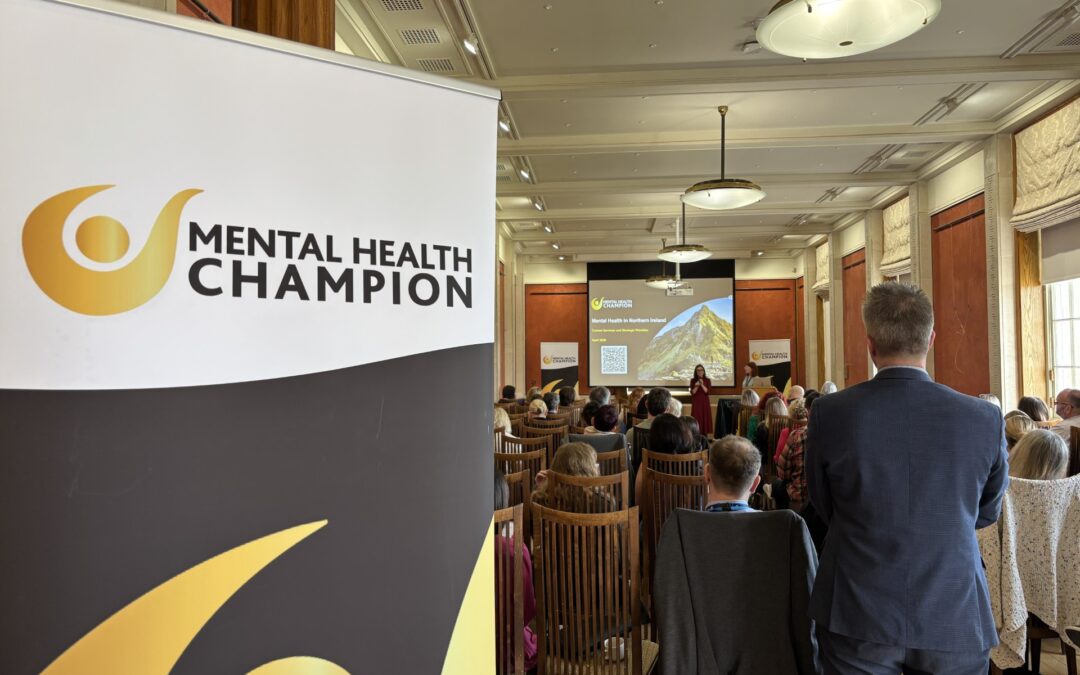
This week, Inspire attended Parliament Buildings in Belfast for the launch of the Mental Health Champion’s (MHC) latest report, Mental Health in Northern Ireland: Current Services and Strategic Priorities.
In introducing the study, Mental Health Champion Professor Siobhan O’Neill spoke candidly of the “moral injury” she has experienced in witnessing the Mental Health Strategy 2021–2031 fail to deliver on its promise. Mental health, she said, “has slipped down the political agenda… in spite of Executive promises.”
That message is reinforced throughout the paper, which stands as one of the most comprehensive, honest and evidence‑based evaluations of Northern Ireland’s mental health system to date. It reflects realities long articulated by Inspire staff, volunteers and service users. A significant portion of the population here is living with the cumulative effects of trauma, poverty and inequality, supported by a system faced with myriad and significant pressures.
These findings also reinforce a concern consistently raised by Inspire, namely that the gap between strategic ambition and operational delivery is now unsustainable. Without decisive action on funding, workforce and prevention, our mental health system will continue to concentrate on risk rather than recovery.
A Life‑Course, Trauma‑Informed Understanding
We strongly commend the report’s adoption of a life‑course approach to mental health, one that recognises the extent to which emotional wellbeing is shaped by the experiences of early childhood and all stages of adulthood. Its clear articulation of the role of intergenerational and conflict‑related trauma, adverse childhood experiences and the cumulative impact of social harm closely aligns with Inspire’s model of care.
This perspective is laid out in the Department of Health’s Neighbourhood Model of Care, as well as our recent blog, Will Ambition Outpace Implementation?, both of which champion placed-based services built on relationships and community infrastructure.
Mental Health Is Shaped by Social Conditions
The emphasis on the social determinants of mental health — from poverty and financial insecurity to housing stress, racism and geographic isolation — is particularly welcome. It reinforces Inspire’s long‑standing assertion that mental distress is often a reasonable response to adverse circumstances.
Through our engagement work and service delivery, we see how individuals are expected to cope with structurally harmful conditions. Effective responses must extend beyond clinical treatment to include practical, relational and place‑based supports rooted in community settings.
Strategy Without Delivery Is No Longer Tenable
The MHC’s conclusions on funding echo points raised by Inspire and others across the voluntary and community sector (VCS). Mental health in Northern Ireland remains significantly under‑resourced compared with other UK jurisdictions and delivery of the Mental Health Strategy has been critically undermined as a result.
Annual budgeting cycles continue to obstruct overdue transformation, destabilise services and erode workforce confidence. Strategy without delivery not only fails systems, it damages trust among service users, families and frontline staff.
Community and Voluntary Sector as Core Infrastructure
The MHC’s explicit recognition of the VCS is as welcome as it is necessary. Reaching people who have disengaged from statutory services, and boasting deep relationships with those they support, voluntary organisations provide early intervention, crisis alternatives and long‑term assistance.
As Inspire has stressed repeatedly in its work on neighbourhood‑based care, the VCS is not supplementary to mental health provision, it is foundational. Without it, prevention efforts and local resilience simply cannot endure.
Right Support, in the Right Place, at the Right Time
Inspire particularly welcomes the report’s distinction between severe mental illness‑driven emergencies requiring specialist clinical intervention, and situational crises rooted in trauma, poverty, addiction, bereavement or housing instability.
This distinction matters because it validates what frontline services see every day. Relational and practical supports play a critical role in preventing escalation and avoiding unnecessary or inappropriate clinical responses. It also reinforces the warning that initiatives like Right Care, Right Person will struggle to succeed without properly resourced community alternatives.
A Workforce Under Strain Across the Whole System
The analysis lays bare the workforce challenges facing the mental health system, mirroring what Inspire sees in statutory partnerships and voluntary provision. Workforce reform has not yet matched the scale or urgency of need and we await the outcomes of the further measures set out in the Mental Health Strategy Deliverability Review, including actions designed to address capacity, sustainability and inclusion throughout all sectors.
A neighbourhood model of care cannot be built on precarious labour and parity of esteem must apply to statutory and VCS workers. Too often, colleagues in the VCS experience greater job insecurity and fewer development opportunities, even while providing essential services. Workforce wellbeing, meanwhile, remains insufficiently prioritised at a system level.
From Evidence to Action
The challenge is no longer about diagnosing the problem. Rather, as this MHC assessment underlines, there now exists a compelling evidence base for immediate action. Inspire believes that the report’s vision, and the ambitions of the Mental Health Strategy, can only be realised through:
-
Multi‑year funding for all sectors
-
Meaningful shift towards prevention and early intervention
-
A comprehensive workforce strategy inclusive of the VCS
-
Reduced regional inequalities and clearer access pathways
-
Lived experience embedded at the heart of system design
Conclusion
The MHC research validates the urgency of reform and the opportunity for change. Inspire is committed to working in partnership with the Northern Ireland Executive, statutory services and communities to build a trauma‑informed and recovery‑oriented mental health system rooted in neighbourhoods, relationships and real lives.

Kyle Duncan
Engagement and Public Affairs Manager

Matthew Coyle
Policy and Campaigns Officer